Janek Rous
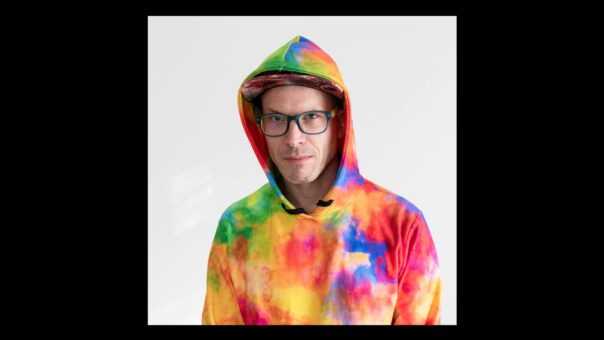
The work of Janek Rous is dominated by performance and the creation of specific situations, which may take the form of subtle interventions (and their simple documentation), as well as monumental narratives captured through film essays or complex video installations. Rous either becomes a solitary actor performing seemingly banal activities in relation to urban or rural environments, or a kind of chess player working with real people, capable of creating unexpected interpersonal constellations on the boundary between reality and abnormality. It is precisely the combination of Rous’s distinctive humor in relation to everyday life and his interest in the “other shore,” the irrational or magical side of reality, that makes his approach highly unique.
One of the first significant bodies of work he created during his studies at Jiří Příhoda’s Studio of Monumental Art at the Academy of Fine Arts in Prague was the series of so-called Generally Non-Beneficial Activities (2007). In the role of a somewhat confused benefactor, Rous photocopies blank sheets of paper, shakes snow off tree branches during a snowstorm, and buys tickets to exhibitions he never visits. These situations were followed by the project Neue dörflichkeit / New Rurality (2009), created in collaboration with Jan Trejbal. The artists undertook nighttime expeditions to urbanistically or communally dysfunctional villages, where they performed small rituals responding to problematic situations such as neighborhood disputes over property boundaries, polluted water, or forgotten “monuments.” Janek Rous continued this line of (un)helpful projects in the action and subsequent installation entitled Stars on Bacon (2010), in which he drank rainwater so that he could water artificial flowers in a hotel with his own urine. By turning the logic of things ad absurdum, the artist inadvertently points to both small and large gaps and blind spots in the organization of the environment in which we live.
Conscious absurdity also dominates a series of performances depicting Rous in relation to architecture. Always dressed in brightly colored clothing, the artist positions himself as a glorified statue atop a residential building (Glory, 2010), or practices balance by sitting at the end of a several-meter-long beam protruding from a bridge over a river (On Stability, 2011). More broadly, Rous’s work creates tension between the city and the landscape, order and deviation, reality and dream. In his more recent projects, however, the dreamlike, illusory, and vaporous component increasingly prevails.
The video diptych entitled Fig. 7 – The King (2011) is an atmospheric composition with a strong audiovisual aesthetic. Already here appears one of Rous’s enduring themes: unfinished stories situated on the edge of mystical visions or optical illusions. A majestic king balancing on a small boat in the middle of a lake within a picturesque mountain pass disappears irretrievably beneath the surface, while in the second video he attempts, in an almost spiritual circle above his own head, to illuminate light bulbs that continually explode. The ritualized circle, this time in relation to a human community, also appears in the subsequent action entitled Waiting for the Turn (2012).
An important work in which the artist approached both the conceptual and technical aspects of installation in an even more comprehensive way is his graduation project — a film essay entitled A Suitable Desert for a Mirage (2013). A widescreen projection combined with a captivating sound installation compels the viewer to move through the space and follow the story of the film from two sides. The work deals with the theme of memory, one of the most surreal components of human personality. The relationship between different temporal planes, memories, and dream images escaping the waking state is also explored in his latest work, Sound from the Desert (2015). Once again, a large-scale spatial video installation depicts the improbable encounter of several individual characters in an open landscape, as if a kind of space-time fissure had emerged in which seemingly unrelated fragments of a story can merge.
At first glance, the overall impression of Janek Rous’s work is dominated by the lightness and humor of unusual situations, yet beneath the surface the artist usually ventures into the mysterious waters of the human psyche and the unexplored corners of the surrounding world. His work does not provide simplifying answers. Through subtle and multilayered gestures, the artist dissects intimately familiar, almost archetypal themes in order to reveal the ambiguity of the reality we co-create.
Janek Rous – Artlist. Source: Artlist. Available online at: https://artlist.cz/umelci/janek-rous/